The best waterfalls near Mysore range from the 16 km-close Balmuri Falls to the powerful twin cascades of Gaganachukki and Barachukki at Shivanasamudra (~80 km), with Hogenakkal (~180 km) as the farthest worth the trip. Most can be visited as a half-day or full-day drive, with June–September offering peak water flow and October–December offering calmer, safer conditions.
If you’re in Mysore with a weekend or even just a free day, you’re closer to some genuinely spectacular waterfalls than most visitors realize. The nearest one is a 30-minute drive; the farthest worth the detour is closer to four hours. What follows is a distance-first breakdown of ten waterfalls around Mysore, organized so you can quickly tell which ones fit a half-day outing and which ones need a full trip planned around them. If you’re building this into a longer itinerary, it’s worth cross-checking against a broader guide to Mysore Tourist Places and Best Time to Visit Mysore so the waterfall leg fits your overall trip rather than working against it.
A quick note before the list: road distances for these places vary a fair bit depending on which route your map app picks, whether you’re coming from the palace side of the city or the ring road, and current road conditions. Treat every distance below as an approximate figure to plan around, not a number to hold your driver to.
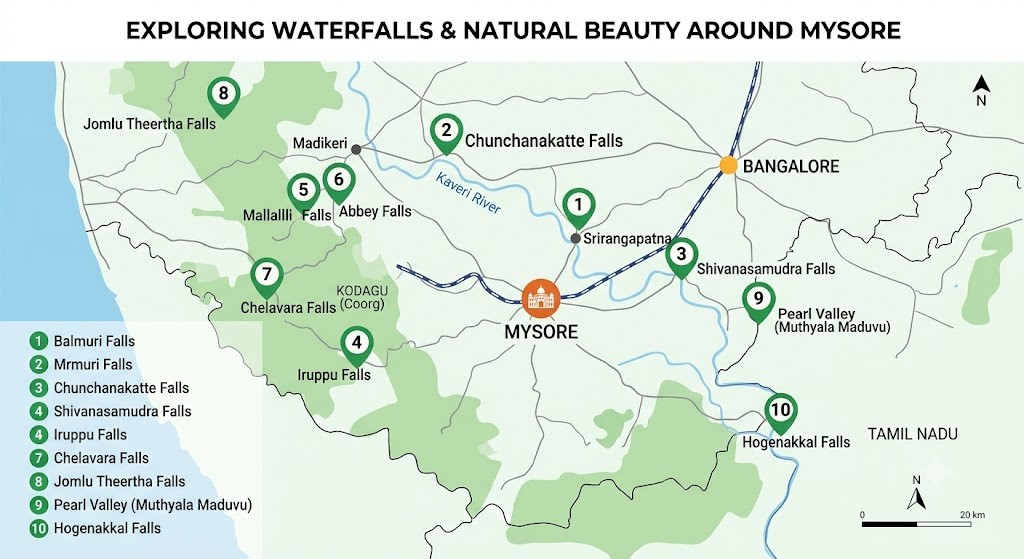
Quick Reference: Distance, Entry Fee & Best Season
| Waterfall | Distance from Mysore | Driving Time | Entry Fee | Best Season |
|---|---|---|---|---|
| Balmuri Falls | ~16 km | ~30–40 min | Free | March–August |
| Chunchanakatte Falls | ~55 km | ~1.5 hours | Free | Monsoon (June–September) |
| Gaganachukki & Barachukki (Shivanasamudra) | ~75–85 km | ~2 hours | Free | June–September (peak flow), Oct–Dec (clearer skies) |
| Iruppu Falls | ~115–120 km | ~3 hours | Small forest entry fee | August–January |
| Mallalli Falls | ~130–140 km | ~3–3.5 hours | Confirm locally | June–September |
| Abbey Falls | ~130–140 km | ~3–3.5 hours | Small fee (varies) | June–September |
| Chelavara Falls | ~125–130 km | ~3 hours | Free (parking charged separately) | Monsoon, viewing only |
| Jomlu Theertha Falls | ~130–150 km | ~3.5 hours | Confirm locally | Post-monsoon (Oct–Feb) |
| Muthyala Maduvu (Pearl Valley) | ~165–175 km | ~3.5–4 hours | Free | August–February |
| Hogenakkal Falls | ~175–180 km | ~4 hours | Free entry (boat rides charged separately) | June–October (boats may pause in heavy monsoon) |
If You’re Looking For…
| Looking For | Best Waterfall |
|---|---|
| Nearest to Mysore | Balmuri Falls |
| Best for Families | Balmuri Falls |
| Biggest / Most Powerful | Gaganachukki & Barachukki (Shivanasamudra) |
| Best for Photography | Gaganachukki & Barachukki (Shivanasamudra) |
| Best for Adventure | Mallalli Falls |
| Best Weekend Trip | Iruppu Falls (Coorg cluster) |
| Best in Monsoon | Chunchanakatte Falls |
How This List Was Selected
The waterfalls here were chosen with a straightforward set of filters rather than an attempt to list every waterfall within driving range of Mysore: driving distance from the city, how popular and well-visited the site actually is, how accessible it is (some require a real trek, others none at all), scenic value, how much the water flow changes across seasons, and what the overall visitor experience looks like once you factor in crowds, safety, and facilities. A few well-known waterfalls further afield in Kerala and Tamil Nadu were left out simply because they stop being a realistic “near Mysore” trip once the drive crosses four or five hours each way. A couple of nearby attractions — like the Sangama-Mekedatu river gorge — are often bundled into “waterfalls near Mysore” lists elsewhere, but they’ve been left out here since they aren’t actually waterfalls, and the same standard is why one or two very minor, seasonal-only falls didn’t make the final ten.
Balmuri Falls — the one you can do before lunch
At roughly 16 km from the city, Balmuri is less a waterfall in the dramatic sense and more a wide, stepped drop in the Cauvery where the river runs over a low check dam. That makes it one of the few entries on this list where families with young kids can wade in safely, provided the water level is calm — it isn’t during heavy release from upstream dams, so it’s worth asking locally before you let anyone in the water.
March through August tends to be the safer window; monsoon months bring stronger currents that aren’t worth testing. There’s no entry fee, and because it’s close to the city, it gets crowded on weekend mornings. Weekday visits are noticeably quieter, and going in the first couple of hours after sunrise is your best bet for both light and a bit of peace. Most visitors spend an hour or two here, and there are small food stalls near the entrance on busier days.
Nearby Ranganathittu Bird Sanctuary makes a natural pairing if you want to turn this into a half-day trip rather than a two-hour errand, and you’ll pass close to KRS Dam on the way out from the city, so it’s easy to combine both stops.
Best for: families with young kids, and anyone with only a couple of free hours.
Chunchanakatte Falls — folklore, a temple, and a genuinely wide falls
About 55 km out, Chunchanakatte is where the Cauvery drops roughly 60 feet across a stretch nearly 350 feet wide, which gives it a horseshoe-like spread rather than a single narrow chute. Local legend ties its origin to Lakshmana striking the ground with an arrow to find water for Sita, and there’s a temple to Kodanda Rama right beside the falls that draws its own visitors independent of the waterfall.
Monsoon (June to September) is when the volume is at its most impressive, though the falls run through most of the year. Because there’s a temple on site, expect some crowd overlap with pilgrims, particularly on weekends and during festival periods — plan around that if you’re mainly there for photography. Parking is informal roadside parking near the temple, and there’s no real walk involved to reach a good view, which makes this an easy stop even with older family members in the group. Small food and tea stalls operate near the temple entrance.
Best for: families and casual sightseers, especially if you’re combining the waterfall with the temple visit rather than treating it as a standalone stop.
Gaganachukki and Barachukki (Shivanasamudra Falls) — the twin falls that justify a full day
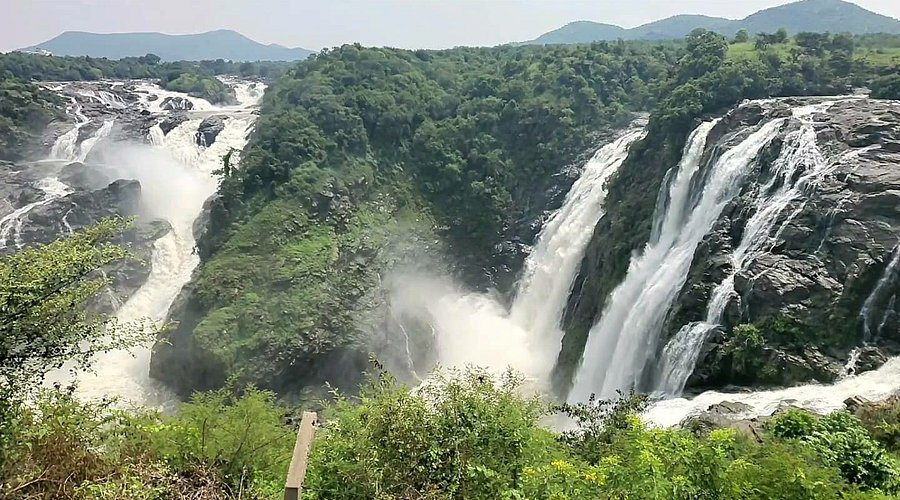
This is the one most travel guides put at the top of the list, and for good reason. The Cauvery splits around an island near Shivanasamudra town and falls through two separate, dramatic cascades — Gaganachukki on the western side, dropping close to 90–98 metres, and Barachukki on the eastern side. Distance estimates from Mysore range from about 75 to 85 km depending on the route (via Bannur–Malavalli is generally the more direct option), so budget close to two hours each way.
There’s no entry fee and the site is open through the day, though visibility and photo quality are best in early morning or late afternoon light. You can’t get close to Gaganachukki — it’s viewed from a watchtower and fenced viewpoints because of dangerously strong currents — but Barachukki has a staircase down to the base and calmer pools where wading is possible in the dry season, plus coracle rides that run seasonally.
Gaganachukki also has some engineering history worth knowing: Asia’s first hydroelectric power station was built here in the early 1900s, and the old plant is still visible from some viewpoints. Weekends and the monsoon season bring heavy crowds, so if photography without a crowd in every frame matters to you, aim for a weekday. Road conditions on the approach are generally good, and there’s enough parking near both viewpoints that this isn’t a stop you need to plan around. Small snack stalls operate near the main viewpoints; a full day trip, including both viewpoints and travel time, is realistic here.
Best for: photographers and couples looking for a proper day trip — the two viewpoints alone are worth a few unhurried hours.
Iruppu Falls — forest trek with mythology attached
Iruppu, around 115–120 km away near the Brahmagiri hill range, involves a short forest walk to reach the falls, which adds a different texture to the visit compared to the roadside falls closer to the city. It’s tied to the same Rama-Lakshmana legend as Chunchanakatte, and devotees visit particularly around Shivaratri believing a dip here has purifying significance.
The falls are at their fullest from August through January; outside that window the flow thins out considerably. Because it sits within a reserve forest area, expect a small entry formality and a short trail on foot rather than a drive-up view. Given the distance, this works best as a weekend trip combined with other stops in Coorg rather than a rushed single-day drive. Parking is available near the forest checkpost, and it’s worth carrying water for the walk in, since options inside the forest area are limited.
Best for: trek lovers and pilgrims combining the visit with its religious significance; less ideal if a forest walk isn’t manageable.
Mallalli Falls — steep, scenic, and best left to the dry-footed
Formed as the Kumaradhara River drops off the Pushpagiri hills, Mallalli is roughly 130–140 km from Mysore and one of the more physically demanding waterfalls to properly view — reaching a good vantage point involves a real climb down (and back up), so it’s not the easiest choice for elderly visitors or very young children.
Typical opening hours run from around 8 AM to 5:30 PM, though it’s worth confirming locally since these can shift seasonally. June through September is peak flow; the falls thin out noticeably by summer. Wear proper shoes rather than sandals — the steps down are uneven and get slippery when wet. Budget at least two to three hours here once the descent, time at the falls, and climb back up are all factored in; food options nearby are minimal, so it helps to carry your own.
Best for: fit, adventurous travelers comfortable with a real climb — not the right pick for elderly visitors or anyone with mobility concerns.
Abbey Falls — quick to reach, often crowded
Located near Madikeri in Coorg, Abbey Falls is roughly 130–140 km from Mysore and one of the more accessible falls on this list in terms of walking distance from the car park — a short paved path gets you to a suspension bridge viewpoint. That accessibility is exactly why it draws heavy crowds, especially in peak monsoon season (June–September) when the falls are at full volume.
It sits on what was originally private coffee estate land, so there may be a nominal entry charge; confirm current rates on arrival since these details change. Given how little walking it needs, it pairs easily with other Madikeri sightseeing on the same day, and most visitors are in and out within half an hour to an hour.
Best for: weekend travelers short on time, since it needs almost no walking — though photographers may find it too crowded in peak season.
Chelavara Falls — look, don’t swim
Chelavara, around 125–130 km out in Coorg, has a natural pool that used to be a popular swimming spot but is now off-limits for entering the water after repeated accidents. You view it from a distance now, via a set of steps down from the road, with car parking typically charged separately at a nominal rate.
It’s worth visiting for the scenery and photography rather than as a place to cool off, and monsoon is when it looks most dramatic. The walk down is short but has uneven steps, so it’s not ideal footwear territory for flip-flops.
Best for: photographers and nature lovers who are fine with viewing rather than swimming.
Jomlu Theertha Falls — pack your own food and water
This one drops from a notable height into a pool below and has a history of drownings during the monsoon, when currents get strong enough that entering the water isn’t advisable even for confident swimmers — the safer window for a dip, if that’s part of your plan, is after the monsoon has passed. There are no food stalls near the falls, so carry supplies with you. Distance from Mysore runs roughly 130–150 km depending on the exact route, putting it firmly in full-day-trip territory.
Best for: nature lovers visiting outside monsoon who don’t mind carrying their own supplies; not an easy casual add-on.
Muthyala Maduvu (Pearl Valley Falls) — smallest on this list, but worth the detour if you’re already near Bangalore
Muthyala Maduvu, meaning “Pearl Valley” in Kannada, is a modest waterfall roughly 165–175 km from Mysore — it’s actually much closer to Bangalore, so it makes more sense as a stop if your route to or from Mysore passes through that side of Karnataka rather than as a dedicated trip from the city itself. It’s set in forest surroundings and open through the day with no entry fee, best visited between August and February.
Best for: travelers already routing through Bangalore rather than a dedicated Mysore day trip.
Hogenakkal Falls — the farthest, and the most different experience
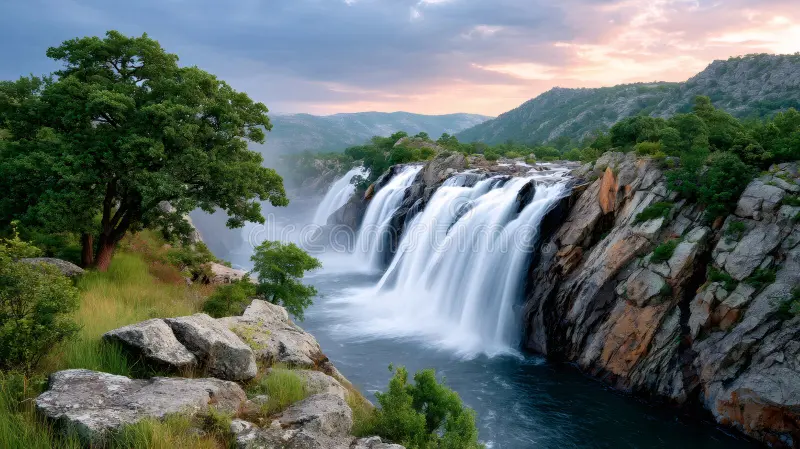
Often called the “Niagara of India” for its volume rather than its height, Hogenakkal sits about 175–180 km from Mysore, technically in Tamil Nadu, and is best experienced from a coracle boat rather than a viewpoint — you’re taken right up near the base of the falls through swirling rapids, which is a genuinely different kind of waterfall visit compared to everything else on this list.
June through October is the recommended window, but boat operations are sometimes paused during the heaviest monsoon surges for safety, so it’s worth checking current conditions before you commit to the full day this trip requires. Entry to the falls area itself is free; the coracle ride is a separate, per-boat charge that’s worth confirming on the day, since rates aren’t fixed year-round.
Best for: travelers who want a genuinely different experience via the coracle ride — less suited to a rushed day trip given the distance.
Which Waterfall Near Mysore Should You Choose?
| Your Situation | Recommended Waterfall | Why |
|---|---|---|
| Only a couple of free hours | Balmuri Falls | Closest option, minimal walking, no entry fee |
| Traveling with elderly parents | Chunchanakatte or Abbey Falls | Both viewable with little to no walking |
| First waterfall trip, want it easy | Gaganachukki & Barachukki | Well-developed viewpoints, no trekking required |
| Want to avoid crowds for photos | Chelavara Falls or a weekday visit to Barachukki | Less-visited or quieter on weekdays |
| Comfortable with a real trek | Mallalli Falls | Steep descent, most physically demanding on this list |
| Planning a Coorg weekend | Abbey, Chelavara, Mallalli, and Iruppu together | All sit close enough to combine over two days |
| Want something other than a static viewpoint | Hogenakkal Falls | Coracle boat ride right up to the falls |
Planning Your Waterfall Trip From Mysore
Grouping by distance makes more sense than a single master itinerary. Balmuri and Chunchanakatte can both be done in a single relaxed day, even with a late morning start. Gaganachukki and Barachukki work well as a dedicated day trip on their own, given the roughly two hours of driving each way. Everything past about 115 km — Iruppu, Mallalli, Abbey, Chelavara, Jomlu Theertha, Hogenakkal — is really an overnight-trip category unless you’re comfortable with a long day of driving and limited time at each stop.
Monsoon is the trade-off season. Nearly every waterfall on this list looks its best from June through September, when water volume peaks — but that’s also when currents are most dangerous, roads to some of the more remote falls can get slippery or waterlogged, and a few sites restrict or pause access entirely for safety. If your priority is safe access over maximum water volume, the shoulder months just after monsoon (October to December) tend to offer a reasonable middle ground: still-green surroundings, calmer water, and fewer access restrictions.
A few things worth carrying regardless of which falls you pick: cash for parking and small entry fees (many of these don’t accept cards), a change of clothes if you plan on wading anywhere water is genuinely safe to enter, and your own drinking water and snacks for the more remote sites like Jomlu Theertha and Iruppu, where shops are scarce or nonexistent. Mobile network coverage also drops off noticeably at several of the forest-adjacent falls, so it helps to download offline maps before you leave Mysore.
On safety near the water: Chelavara and Jomlu Theertha in particular have documented histories of drowning incidents, mostly from people underestimating current strength in pools that look calm on the surface. Where a site restricts entry into the water, that’s usually based on real accident history rather than excessive caution, and it’s worth respecting even if other visitors around you aren’t.
If you’re mapping this out against a full Mysore itinerary, it’s worth checking a Mysore Trip Budget guide too — the Coorg-side waterfalls in particular add a meaningful amount to fuel and, if you stay overnight, accommodation costs that a single-day Mysore plan wouldn’t otherwise include.
A Note on Accuracy
Distances, road conditions, opening hours, and water levels at these waterfalls can change depending on rainfall, reservoir releases, or decisions by local authorities — a few sites have paused access entirely in past years after heavy rain or safety incidents. The figures and seasonal windows above reflect the most consistent information available at the time of writing, but it’s worth verifying current conditions, especially for anything you’re planning around a specific date, before you set out.
Read Also: Best Sunset Points in Mysore: 10 Scenic Places to Watch the Sunset in 2026
Frequently Asked Questions
Which waterfall near Mysore is best for a half-day trip with kids?
Balmuri Falls, given its proximity and generally gentle water levels outside monsoon, is the most realistic option for young children. Chunchanakatte is a reasonable second choice since it doesn’t require any trekking to view.
Do any of these waterfalls charge an entry fee?
Most are free to view, though a few — Abbey Falls in particular — may have a small entry charge tied to the estate land they sit on, and several sites charge a nominal parking fee rather than an entry fee. These amounts change, so it’s best to confirm on arrival rather than budget for an exact figure in advance.
Is it safe to swim at these waterfalls?
Only at a handful of them, and only outside monsoon season. Balmuri and parts of Barachukki (at Shivanasamudra) are the more commonly used spots for wading, but conditions change with water release from upstream dams, so ask locally on the day rather than assuming based on what you’ve read here.
Which waterfalls are accessible without much walking or trekking?
Balmuri, Chunchanakatte, and Abbey Falls involve minimal walking. Mallalli, Iruppu, and Jomlu Theertha all require a proper walk or descent to reach a good viewpoint, which is worth factoring in if you’re travelling with elderly family members.
If you’re only picking two or three from this list for a single trip, distance and physical accessibility will narrow it down faster than anything else — start with what’s realistic for your group’s mobility and time, then let the season decide the rest.
Planning Tip: If you’re visiting during the monsoon, start early in the morning because popular waterfalls such as Shivanasamudra and Abbey Falls become crowded by late morning on weekends. Carry a light rain jacket, non-slip footwear, drinking water, and check local weather before leaving Mysore.

Rahul Sharma is the founder and editor of BrindavanaGarden.com. He researches Brindavan Gardens, Mysore tourism, and nearby attractions using Karnataka Tourism resources, official websites, visitor reviews, maps, and trusted travel references. Every guide is carefully reviewed and updated to keep practical information such as timings, entry fees, travel tips, and visitor advice as accurate and useful as possible. His goal is to help travelers plan smoother, better-informed trips to Brindavan Gardens and the surrounding Mysore region.