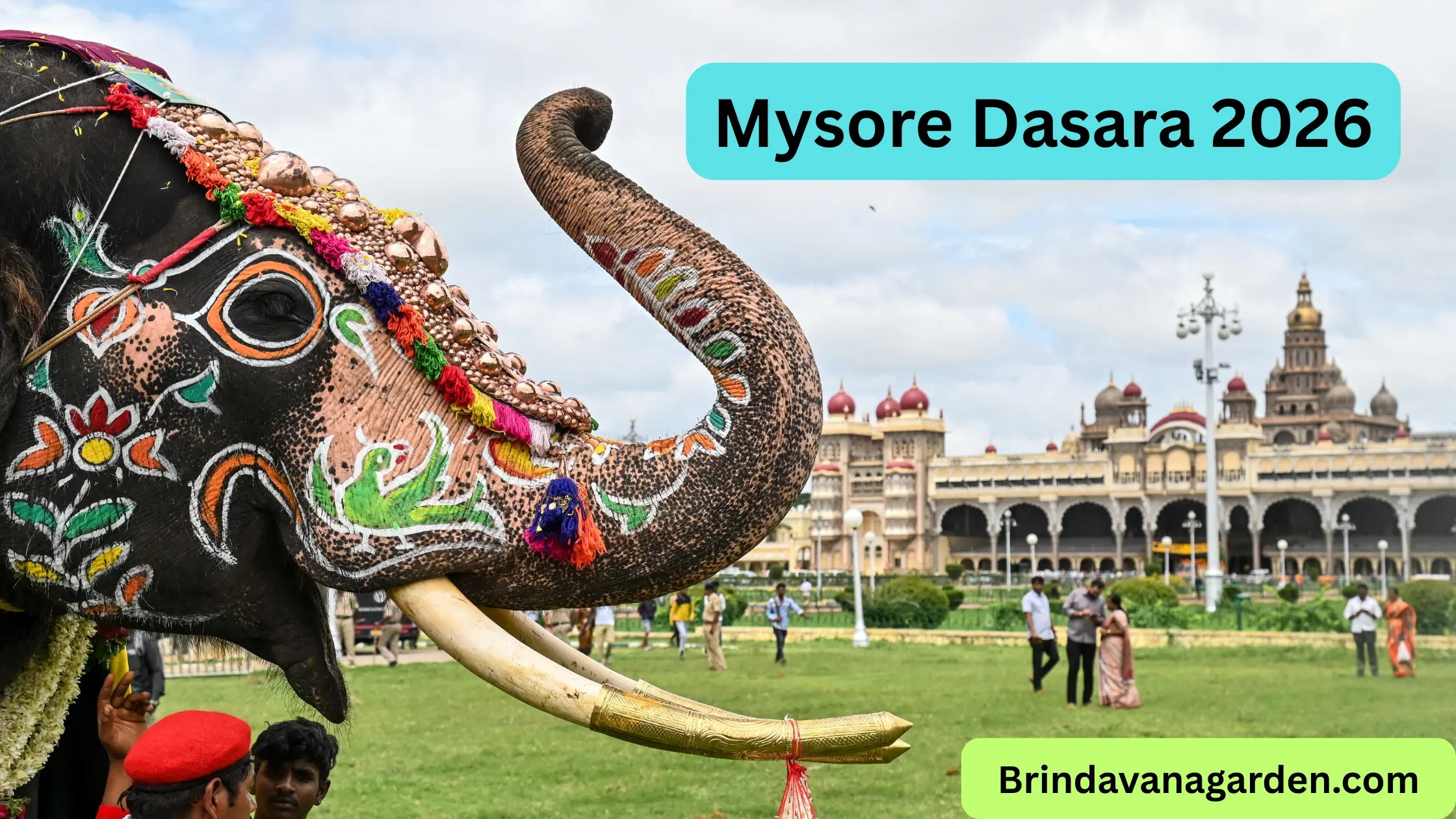
Planning to visit Mysore during Dasara 2026? This guide covers the confirmed festival dates, major events, Jamboo Savari, palace illumination, travel tips, accommodation advice, and practical information to help you plan your trip.
When Mysore Dasara 2026 Falls, and Why the Exact Date Matters
Mysore Dasara 2026 will be celebrated from Sunday, 11 October 2026 to Wednesday, 21 October 2026. The opening rituals begin early — the festivities on Chamundi Hill start with a Pooja to Goddess Chamundeshwari between 10.10 am and 10.40 am on 11th October, and the public side of the festival kicks off the same evening with a Cultural Programme inauguration at Mysore Palace Grounds by the Chief Minister of Karnataka at 5.00 pm.
This date isn’t fixed on the regular calendar because Dasara follows the lunar Hindu calendar, tied to the Ashwin month and the Navratri period. That’s why you can’t just remember “mid-October” from a previous trip and assume it’ll match this year.
Because hotel prices and transportation can change quickly during the festival, booking a few weeks in advance is usually a better idea than waiting until the last minute. If you’re booking flights or hotels around this festival, always cross-check the current year’s dates rather than going by what worked last year. That’s why you can’t just remember “mid-October” from a previous trip and assume it’ll match this year. If you’re booking flights or hotels around this festival, always cross-check the current year’s dates rather than going by what worked last year.
A practical note before you plan further: while the start and end dates (11th to 21st October) are consistent across multiple festival-tracking sources, some of the finer details — like exact minute-by-minute puja timings on individual days — are announced closer to the event by the Karnataka government and the Mysore Palace Board. If a specific timing matters for your itinerary, it’s worth checking the official Mysore Dasara website or Karnataka Tourism closer to your travel date, since these can be adjusted.
Major Events You Shouldn’t Miss During Mysore Dasara 2026
Dasara isn’t one single event you show up for — it’s a festival that unfolds over several days, and knowing its overall schedule helps you decide how much time you actually need in Mysore.
The opening day (11th October) sets the tone. The hilltop rituals at Chamundi Hill happen in the morning, and the palace grounds come alive in the evening with the official cultural inauguration. If you’re only in town for the start, this is your day.
The middle days are where the festival runs on a steadier rhythm — each day of Navratri is dedicated to a different form of the Goddess, such as Brahmacharini Pooja on the second day and Chandraghanta Pooja on the third. Alongside these religious observances, the city runs daily cultural programs, food stalls, and exhibitions that don’t depend on any single “big day” — you can walk into most of these on any evening during the festival window.
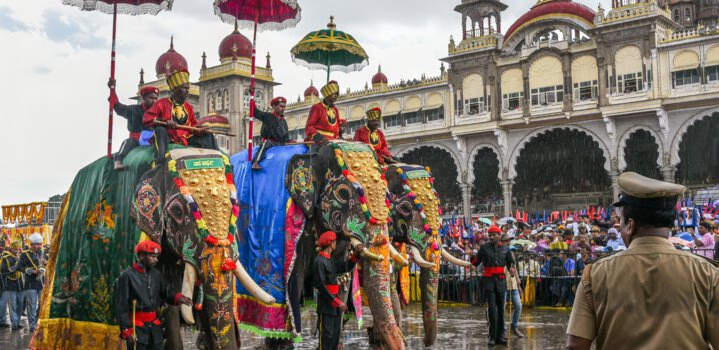
Mahanavami, the ninth day, is when the royal sword is taken out and worshipped, followed by a procession that includes elephants, camels, and horses — smaller in scale than the main event but a strong preview of what’s coming.
Vijayadashami, the tenth day (21st October), is the day almost everyone is actually planning their trip around. This is when the Jamboo Savari procession happens, along with two ceremonies earlier that day at the palace — the Chief Minister performs Nandi Dhwaja Pooja between 1.00 pm and 1.18 pm, followed later by floral tributes offered to the idol of Goddess Chamundeshwari, seated in the 750-kg Golden Howdah, between 4.42 pm and 5.06 pm.
The same night closes with the Torchlight Parade (Panjina Kavayatthu) at Bannimantapa, scheduled from 7.00 pm to 10.00 pm on 21st October — the formal end of the festival.
Since the golden howdah, procession, and torchlight parade are the three things most visitors travel specifically to see, and all three fall on the last day, that single day carries more weight in your itinerary than any of the other nine.
Read Also: 2 Days in Mysore: Complete Travel Itinerary for Families and Couples
If You Can Only Pick 2–3 Days, Pick These
Not everyone can block out eleven days for a festival trip, and honestly, you don’t need to. If your time is limited, here’s how to get the most out of a short visit.
If you can only manage one day, make it the 21st. This is non-negotiable if seeing the procession is your main reason for coming. You’ll catch the palace ceremonies in the afternoon and the Jamboo Savari procession, and if you stay on, the torchlight parade in the evening. It’s a long day, but it’s the one day that concentrates almost everything people associate with Mysore Dasara.
If you have two to three days, add the opening day (11th October) and one evening in the middle of the festival. The opening day gives you the ceremonial start and the first cultural programme at the palace grounds, without the extreme crowd density of Vijayadashami. A middle evening — any day between the 12th and the 19th — lets you experience the illuminated palace, walk the exhibition grounds, and try festival food without competing with peak-day crowds. This combination gives you the atmosphere of the festival without forcing you to survive its busiest single day twice.
Avoid trying to “cover everything” in a rushed single overnight trip. Mysore during Dasara has heavier traffic and fuller hotels than usual, and if the 21st is part of your plan, you’ll want at least one buffer day around it rather than arriving and leaving on the same day.
Jamboo Savari: What It Is, Where to Stand, and Getting a Real View
Jamboo Savari is the procession that most people picture when they think of Mysore Dasara — the image of a decorated elephant carrying the golden howdah is practically the symbol of the festival. The procession covers roughly five kilometers, starting from Mysore Palace and ending at Bannimantapa, where the ceremonial Banni tree worship takes place. Along the way, the procession includes tableaux, dance groups, music bands, decorated elephants, horses, and camels, so it’s a lot more than just the one elephant carrying the idol — the full parade takes time to pass any single point.
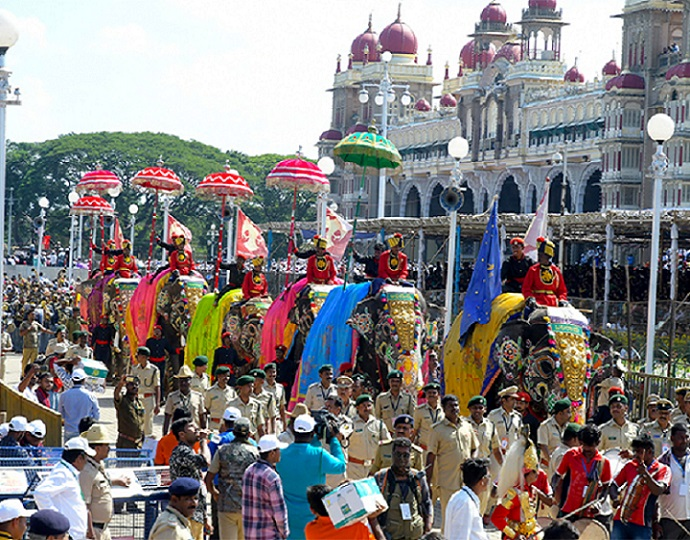
Here’s what first-time visitors tend to get wrong about watching this: they assume they can walk up close to the palace gates on the day itself and get a good spot. In practice, the areas directly around Mysore Palace get extremely crowded well before the procession starts, and access near the start point is tightly controlled with barricades and security checks. If you want a spot near the palace, you need to be in position hours early — realistically, by late morning for an afternoon procession.
A more comfortable alternative is to pick a spot further along the five-kilometer route rather than right at the start. Carry drinking water, wear comfortable footwear, and expect security checks at major viewing points, especially near the palace. Areas closer to the middle or later stretch of the route toward Bannimantapa tend to be less packed, and you still get a clear view of the full procession as it passes. Elevated spots — hotel balconies, upper floors of buildings along the route, or paid viewing galleries if the Palace Board sets them up that year — are worth looking into in advance if you want to avoid standing in a dense crowd for hours.
One more thing worth knowing: seating or gallery arrangements for viewing the procession, if any are officially set up for 2026, are usually announced by the Mysore Palace Board only a few weeks before the event. If you want guaranteed seating rather than open street viewing, check official Karnataka Tourism or Mysore Palace announcements closer to October rather than assuming last year’s arrangement will repeat exactly.
Also SEE: Mysore Palace Opening Time Today for Visitors 2026
The Torchlight Parade (Panjina Kavayatthu): The One Event That Needs a Ticket
Once the Jamboo Savari procession reaches Bannimantapa, the festival doesn’t just wind down — it closes with the Torchlight Parade, locally called Panjina Kavayatthu, scheduled from 7.00 pm to 10.00 pm on 21st October 2026. This is a separate event from the daytime procession, held after dark, and it has its own character: performers carrying torches, marching bands, and a display that’s built specifically for evening viewing rather than being a continuation of the same crowd from earlier in the day.
The key difference visitors need to know is that this isn’t a walk-up, open-street event like the Jamboo Savari. In past years, the Torchlight Parade has required a ticket or registration to attend, since seating at Bannimantapa is limited and organized differently from the open procession route. If getting into this specific event matters to your plan, don’t treat it as something you can decide on the day — ticketing details, prices, and the registration process for 2026 should be confirmed through the official Mysore Dasara website or Karnataka Tourism closer to the event, since these aren’t finalized far in advance and can change year to year.
If you arrive without a ticket and the event is at capacity, you may still be able to catch parts of it from outside the immediate seating area, but visibility will be limited. Since this is the closing event of the festival, it’s worth sorting out ticket access before you finalize your travel dates rather than after.
Mysore Palace After Dark: The Illumination Everyone Comes For
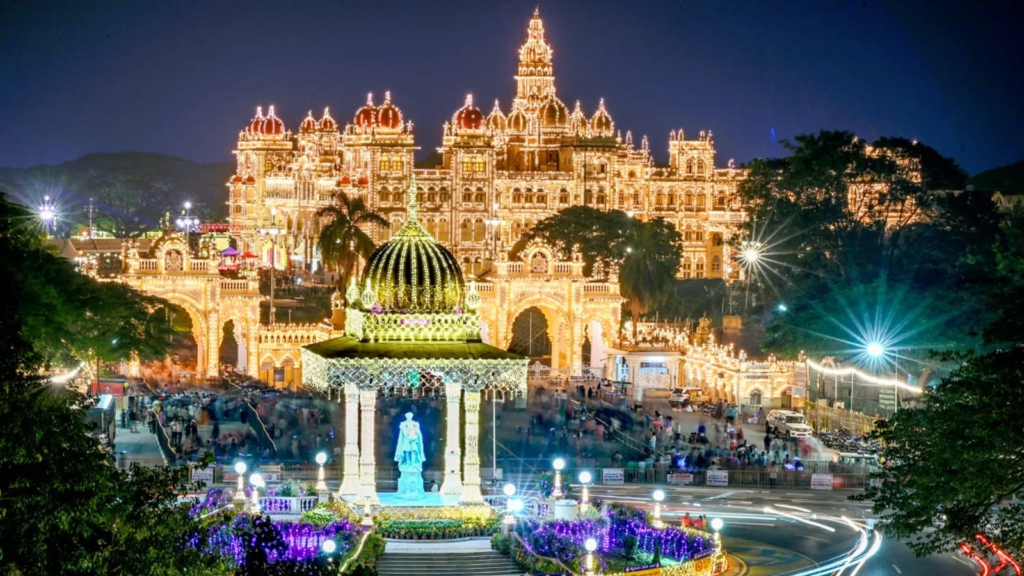
Separate from the processions, the palace illumination is its own reason people plan a Dasara trip. Mysore Palace is lit with roughly one lakh light bulbs during the festival period, and the effect is dramatically different from how the palace looks on a normal evening visit — the entire structure, not just the entrance, is outlined in light.
The illumination schedule is announced separately for each Dasara season. Before planning your evening visit, check the official Mysore Dasara or Mysore Palace website for the latest timings. Exact lighting days and timings for 2026 — including whether it’s lit every single night of the festival or only on select days — should be checked closer to your visit, since this schedule is announced separately from the main festival program and isn’t always identical to previous years.
For viewing, the area directly in front of the palace gets crowded in the evenings during festival week, more so than on the procession day itself in some cases, because it doesn’t require any special access — anyone can walk up and see it. If you want a less crowded experience, visiting on a weekday evening during the middle stretch of the festival (rather than the opening or closing days) usually means smaller crowds. Arriving right at dusk, before the lights are fully appreciated in the dark, also gives you a bit more room to find a good spot before the evening crowd builds up.
Where to Stay Without Losing Half Your Day to Traffic
Location matters more during Dasara than on a regular Mysore trip, because the roads around the palace and the procession route get closed or heavily congested on key days. Staying too far out means you could lose hours just getting into the city center on the days that matter most.
Areas within walking distance or a short auto ride from the palace — roughly the central Mysore zone — are the most convenient for festival days, especially if you’re planning to watch the Jamboo Savari or the palace illumination without relying on a vehicle. The trade-off is that hotels in this zone book up fastest and their prices increase the most as the festival approaches.
If central hotels are full or overpriced by the time you’re booking, staying slightly further out and planning to walk the last stretch on procession day is usually more reliable than trying to drive in, since vehicle access near the palace is restricted on the 21st. Areas that are a 15–20 minute ride from the center on a normal day can work well, as long as you build in extra time for traffic on festival dates specifically.
One practical point: hotel rates in Mysore during Dasara season, particularly for the days around the 21st, rise well above regular pricing, and rooms in central areas can sell out weeks in advance. If your trip includes Vijayadashami, it’s worth booking your stay as early as you’ve confirmed your dates rather than waiting until closer to October.
Getting to Mysore During Dasara Week
Mysore has its own airport, but flight connectivity is limited compared to Bengaluru, so most visitors — especially those flying in from other states — land in Bengaluru and travel to Mysore by road, a journey that normally takes around three hours.
During Dasara week, that road journey can take noticeably longer, particularly close to the festival’s opening and closing days, since traffic volume into Mysore increases with visitor numbers. If you’re traveling by road on the 11th or the 21st specifically, it’s worth building in extra buffer time rather than cutting it close.
Within the city itself, expect certain roads near the palace and along the procession route to be closed to regular traffic on Vijayadashami, with diversions in place. Local autos and cabs are usually still available, but drivers may not be able to get you all the way to your destination if it’s near the restricted zone — walking the last stretch is common on that day. If you’re relying on a rented car, parking near the city center on festival days can be difficult to find, so many visitors choose to park further out and use local transport for the final leg.
For anyone unfamiliar with Mysore’s layout, it’s worth checking Karnataka State Road Transport Corporation (KSRTC) or local traffic advisories closer to your travel dates, since road closures and diversions for 2026 are typically announced only in the days leading up to the festival.
Food Mela, Exhibition Grounds, and the Quieter Side of Dasara
Not every part of Dasara revolves around processions and crowds. The Dasara Exhibition, held on the grounds opposite Mysore Palace, is one of the more relaxed things to do during your visit — it typically runs well beyond the eleven official festival days, often continuing into December, so you don’t need to time your visit around a specific date to catch it. Expect stalls selling clothing, handicrafts, kitchenware, and a mix of games and rides, more like a large fairground than a festival-specific event.
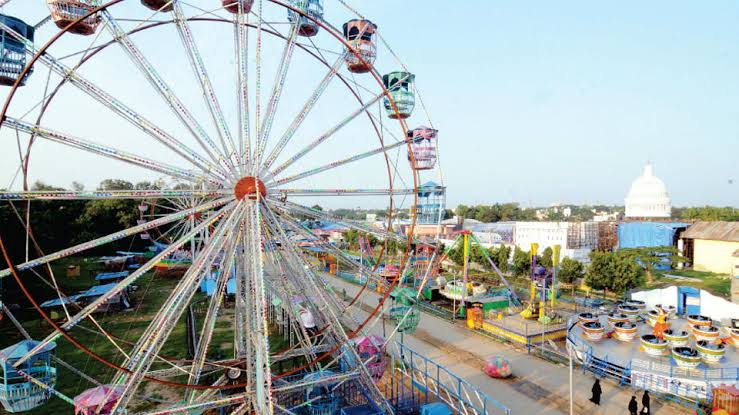
The Food Mela is another draw, with stalls set up around the city offering a range of regional food through the festival period. This is a good option if you want a taste of the festival atmosphere without dealing with procession-day crowds — most food stalls run daily throughout the festival window, not just on the big dates. Most stalls accept digital payments, but carrying a small amount of cash can still be useful at temporary festival stalls.
There are also smaller cultural programs happening across multiple venues in the city each evening — music, dance performances, and similar events that don’t require tickets or advance planning. These are worth checking into if you’re staying multiple days and want something to do on the evenings that aren’t the 11th or the 21st.
Common Mistakes First-Time Visitors Make During Mysore Dasara
A few patterns come up again and again with visitors who are attending for the first time, and most of them are avoidable with a bit of planning.
Booking accommodation too late. Hotel rooms in central Mysore fill up fast for the festival period, and prices climb steadily as the dates get closer. Waiting until a few weeks before October to book is the single most common regret visitors report. If you’re visiting only for Vijayadashami, booking 2–3 months in advance usually gives you more hotel choices and better prices.
Assuming you can walk right up to the procession route on the day. As covered earlier, the areas near the palace get restricted and crowded well before the Jamboo Savari begins. Showing up an hour before doesn’t work the way it might for a regular event.
Underestimating how long you’ll be standing or walking. Festival days, especially the 21st, involve long stretches of waiting in crowds, often in October heat. Visitors who don’t plan for water, shade breaks, or comfortable footwear tend to cut their day short.
Not checking ticket requirements for the Torchlight Parade in advance. Unlike the open-street procession, this event has historically needed registration or tickets. Visitors who assume it’s walk-in, like the daytime events, sometimes find themselves unable to get a seat.
Trying to see everything in a single rushed day. Dasara isn’t built for a same-day arrival-and-departure visit if you want to see the palace illumination, the procession, and the torchlight parade all together — these are spread across the day and into the night, and back-to-back travel on top of that is exhausting rather than enjoyable.
Ignoring city-specific traffic patterns on procession day. Regular travel times within Mysore don’t apply on the 21st. Visitors who plan their day using normal travel estimates often end up missing the start of an event they specifically traveled for.
Before You Finalize Your Trip
The core dates for Mysore Dasara 2026 — 11th to 21st October — along with the key ceremony timings on the opening and closing days, are consistent across multiple festival-tracking sources at the time of writing. The broad shape of the festival, from the Chamundi Hill inauguration to the final torchlight parade, is well established and unlikely to change.
That said, a few specifics are worth confirming closer to your travel date directly from official sources — the Mysore Dasara government website or Karnataka Tourism:
- Exact Torchlight Parade ticketing and registration process for 2026
- Palace illumination schedule — which specific nights and hours it runs
- Any official seating or viewing gallery arrangements for the Jamboo Savari procession
- Road closures and traffic diversions in the days immediately before the 21st
- Minor puja timings on individual days between the 12th and 19th, if these matter to your itinerary
None of these are likely to shift the overall dates of your trip, but they can affect the smaller decisions — where you book, how you get around on the big days, and whether you need to arrange tickets in advance. A quick check a few weeks before your trip can help you avoid last-minute surprises and plan your visit more smoothly.

Rahul Sharma is the founder and editor of BrindavanaGarden.com. He researches Brindavan Gardens, Mysore tourism, and nearby attractions using Karnataka Tourism resources, official websites, visitor reviews, maps, and trusted travel references. Every guide is carefully reviewed and updated to keep practical information such as timings, entry fees, travel tips, and visitor advice as accurate and useful as possible. His goal is to help travelers plan smoother, better-informed trips to Brindavan Gardens and the surrounding Mysore region.