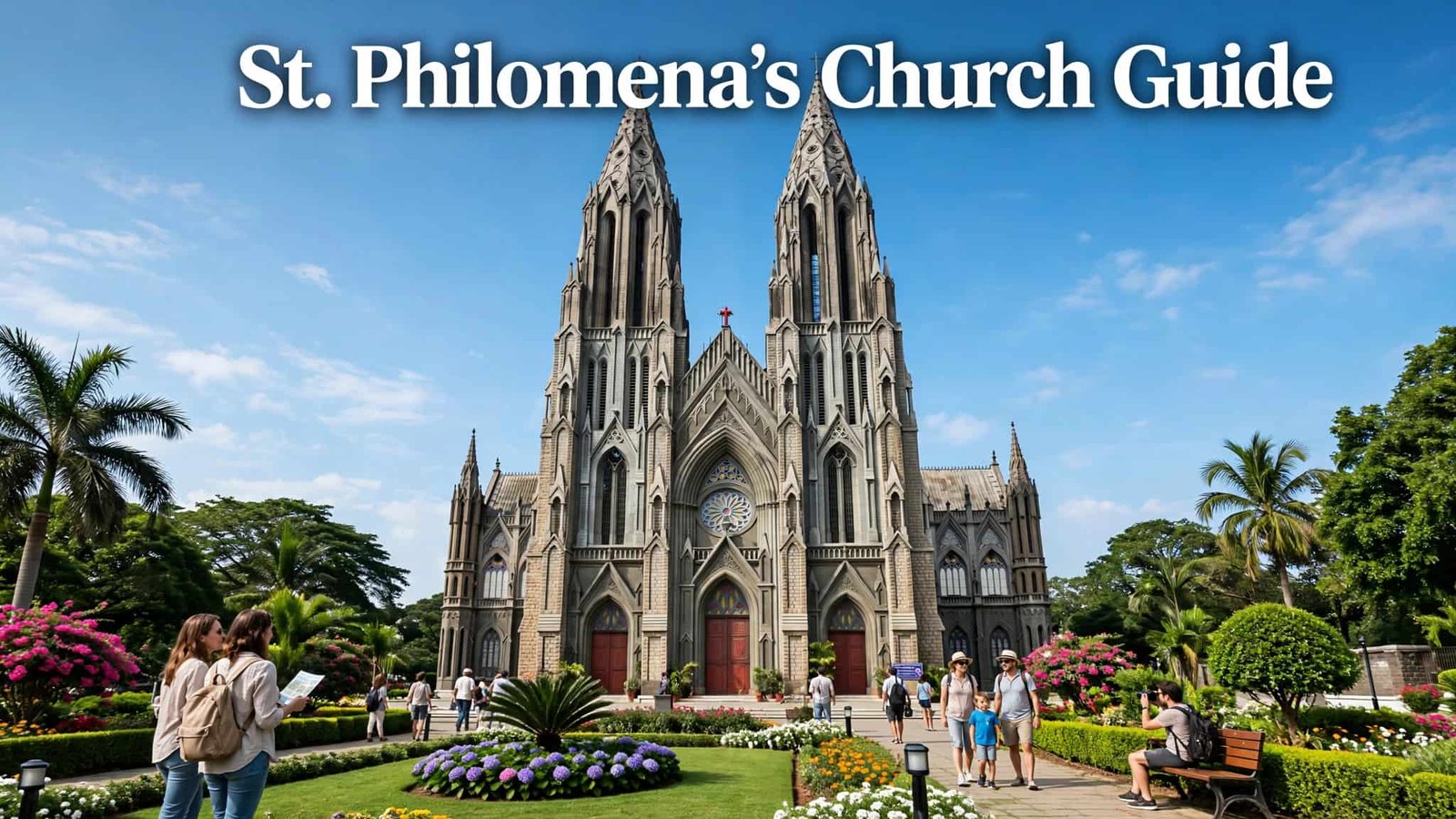
Right in the heart of Mysuru, a short distance from the palace, twin Gothic spires rise well above the surrounding rooftops — and if you didn’t know better, you might guess you’d wandered into a European city rather than a South Indian one. That’s St. Philomena’s Church, one of the tallest churches in Asia, and one of Mysuru’s most visited landmarks after the palace itself.
A Brief History
The story of St. Philomena’s Church actually spans two structures, not one. The first church on this site was built in 1843, established to serve Mysuru’s growing Catholic community, largely made up of European residents at the time. As the congregation grew, that original building could no longer accommodate the crowds, and a much larger, grander structure was commissioned.
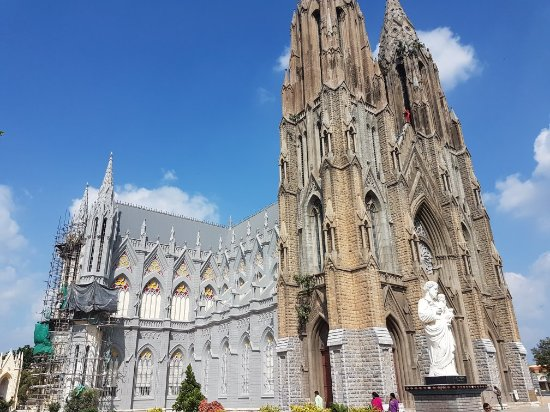
Construction of the church you see today began in 1933 and took roughly eight years to complete, finishing in 1941. It was built under the patronage of Maharaja Krishnarajendra Wadiyar IV, designed in Neo-Gothic style and modeled closely on Germany’s Cologne Cathedral, with some accounts also drawing comparisons to St. Patrick’s Cathedral. The twin spires reach around 175 feet, making it, by most accounts, the second tallest church in Asia.
The church is dedicated to Saint Philomena, a young Greek martyr from the early centuries of Christianity, and it’s said that relics associated with the saint are preserved within the church to this day.
Visiting Hours
St. Philomena’s Church is generally open daily from around 5:00 AM to 6:00 PM, though a few sources note the church may stay open later, up to around 8:30 PM, particularly around festival periods. Since timings can shift slightly for special occasions, it’s worth checking ahead if you’re planning an evening visit specifically.
Entry to the church and its small museum area is free for all visitors, regardless of faith.
Mass Timings
For those attending for worship rather than sightseeing, Holy Mass is conducted multiple times daily:
- Weekdays: typically several morning sessions (around 5:30 AM, 6:15 AM, and 7:00 AM) plus an afternoon session around 4:00 PM
- Sundays: additional morning sessions, often starting as early as 5:00 AM and continuing hourly through mid-morning, plus the regular afternoon Mass
Exact timings can vary, so if attending Mass is your specific purpose, checking with the church directly closer to your visit date is the safer bet.
Architecture Worth Noticing
Even if you’re not particularly drawn to religious architecture, St. Philomena’s is genuinely worth slowing down for. Inside, look out for:
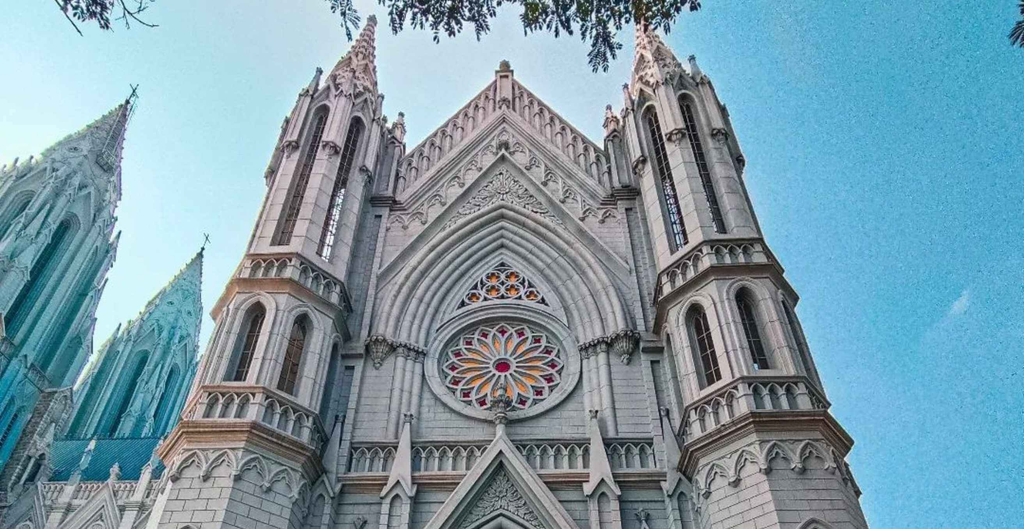
- Stained glass windows depicting biblical scenes, which catch dramatic light through the day
- Vaulted ceilings and carved wooden doors, typical of the Neo-Gothic style
- The overall symmetry of the twin-spire facade, best appreciated from across the street rather than right up against the entrance
The church tends to look especially striking in the early evening, when the facade catches the last of the daylight — a detail photographers in particular tend to appreciate.
Rules to Know Before You Go
- Photography inside the main church hall is generally not permitted. Exterior photos are fine, and this is in fact one of the more photogenic buildings in Mysuru from the outside.
- Modest dress is expected, as with any active place of worship — this isn’t a place for beachwear or overly casual clothing.
- Keep noise levels low inside, particularly during ongoing Mass or if other visitors are praying quietly.
- An annual feast is held on 11th August each year, drawing larger crowds than a typical day — worth knowing if your dates happen to overlap.
Getting There
St. Philomena’s Church is centrally located, just about 2 km from Mysore Palace and roughly 2.5–3 km from Mysore Junction railway station and the KSRTC bus stand. Given how central it is, reaching the church is simple from almost anywhere in the city:
- By auto-rickshaw or taxi: The most convenient option, widely available and inexpensive for such a short distance.
- By local bus: Several city bus routes pass close to the church, though an auto or cab is generally faster for a trip this short.
- On foot: If you’re already exploring central Mysuru — say, after visiting the palace or Devaraja Market — the church is close enough to comfortably walk to, depending on the day’s heat.
Accessibility
The main entrance is generally described as wheelchair accessible, with assistance available for visitors who need it — a detail worth knowing if you’re traveling with elderly family members or anyone with mobility considerations.
Best Time to Visit
Time of year: October through February offers the most pleasant weather for exploring central Mysuru on foot, which matters here since the church is often combined with other nearby stops.
Time of day: Early morning tends to be the quietest, giving you a peaceful look at the interior before tour groups and other visitors arrive. If photography is your main goal, late afternoon light on the facade is particularly flattering.
Combining Your Visit
Because of how central it is, St. Philomena’s Church works well as part of a half-day walking loop through Mysuru’s old city — pair it with Mysore Palace (about 2 km away) and Devaraja Market, both within easy reach, to cover three of the city’s most distinctive landmarks without needing a vehicle for most of the route.
Quick Reference
| Detail | Information |
|---|---|
| Built | Original 1843; current structure 1933–1941 |
| Architectural style | Neo-Gothic, inspired by Cologne Cathedral |
| Height | Approx. 175 feet (twin spires) |
| Visiting hours | Approx. 5:00 AM – 6:00 PM (may extend on some days) |
| Entry fee | Free |
| Photography inside | Not permitted |
| Distance from Mysore Palace | ~2 km |
| Annual feast | 11th August |
Once you’ve explored the church, Devaraja Market is close enough for a quick walk if you’re keen to pick up some Mysore silk, sandalwood products, or local spices before heading to your next stop.
Read Also: Chamundi Hills Mysore: Temple Timings, How to Reach & Complete Visitor Guide
1 thought on “St. Philomena’s Church, Mysore: History, Timings & Complete Visitor Guide”