If you have only seen Brindavan Gardens after sunset, with the fountains running and the whole place lit up, you have seen just one side of it. The History of Brindavan Gardens goes back to the late 1920s, when the garden was developed alongside the Krishna Raja Sagara (KRS) Dam. Work on the garden started in 1927 and was completed around 1932.
I have been to Brindavan Gardens many times, and honestly, the place feels different once you know why it was built. The long water channels, neat terraces, lawns and flower beds were not simply put there to make the area look pretty. There was a proper plan behind them.
The garden grew as part of the development around the KRS Dam during the old Mysore State period. At that time, the idea was to create something useful as well as beautiful around a major engineering project.
Today, most visitors come for the musical fountain. Fair enough. It is fun, especially with family. But if you walk around in the afternoon and actually look at the layout, you start noticing the older character of the garden.
And that, for me, is the interesting part.
Quick Information
- Location: Below the KRS Dam, near Krishnarajasagara, Mandya district, Karnataka
- From Mysuru: About 20–21 km by road
- Garden area: About 60 acres
- Garden development: 1927–1932
- Associated with: KRS Dam and the Kaveri River
- Key figure: Sir Mirza Ismail, then Diwan of Mysore
- Landscape designer: Gustav Hermann Krumbiegel
- Garden style: Terraced layout with Mughal-style influences
- Best time to visit: Late afternoon and evening
- Main attraction today: Musical fountain and illuminated gardens
Note: Timings and charges can change, so check the latest notice at the entrance before your visit.
History of Brindavan Gardens: How It Started
To understand the History of Brindavan Gardens, you first need to understand the KRS Dam.
The two are closely connected.
The Krishna Raja Sagara Dam was developed across the Kaveri River as an important irrigation and water-supply project for the region. The project became one of the major engineering achievements associated with the old Mysore State. According to the Mandya district administration, work on the dam took place from 1911 to 1932.
As the dam project progressed, the Mysore administration also looked at improving the surroundings.
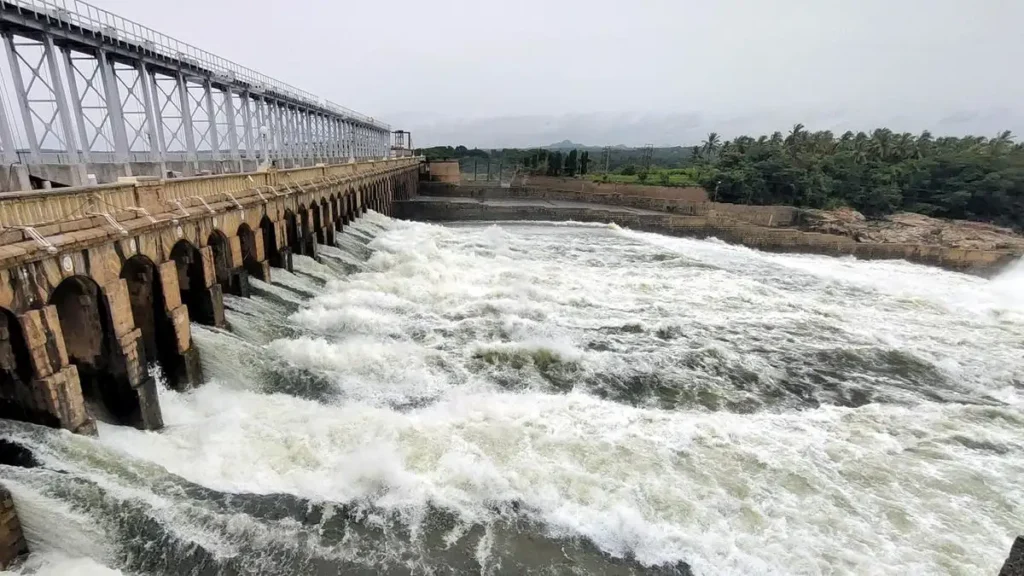
That is where the garden came into the picture.
Work on Brindavan Gardens began in 1927 and continued for roughly five years. The garden was completed around 1932. Its development is strongly associated with Sir Mirza Ismail, who was the Diwan of Mysore during this period.
The idea was not simply to plant a few trees near the dam and call it a garden.
The entire landscape was planned.
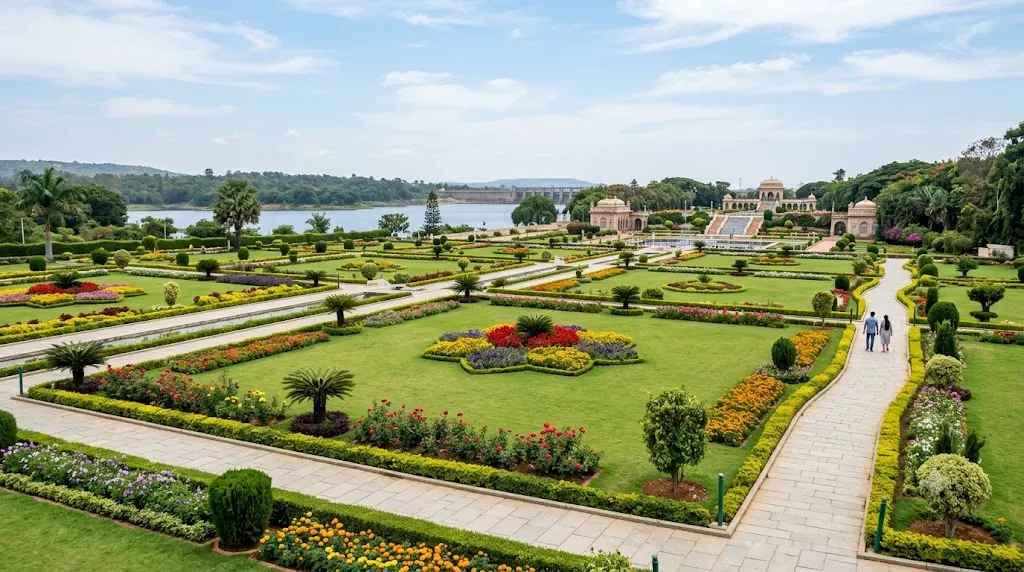
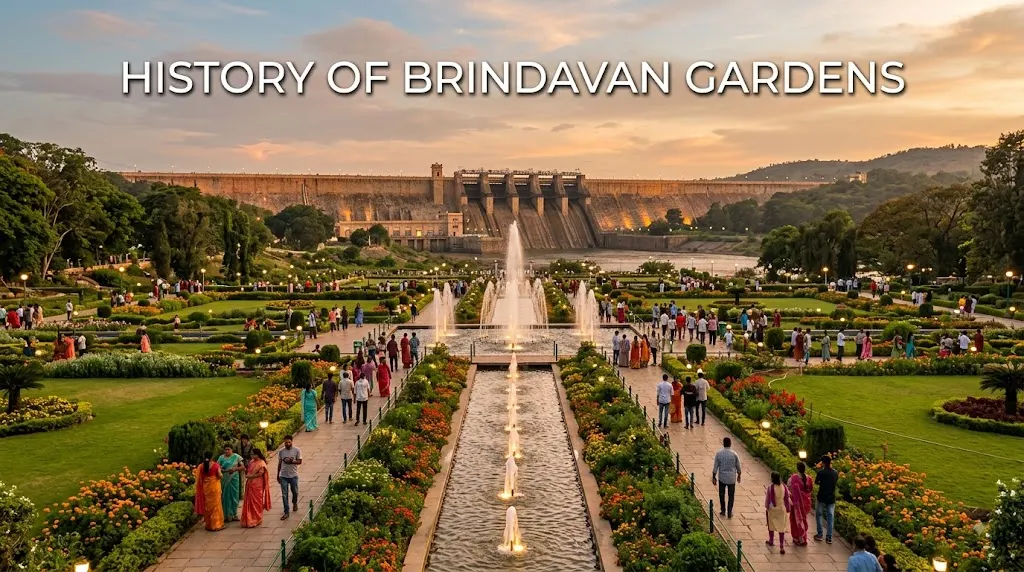
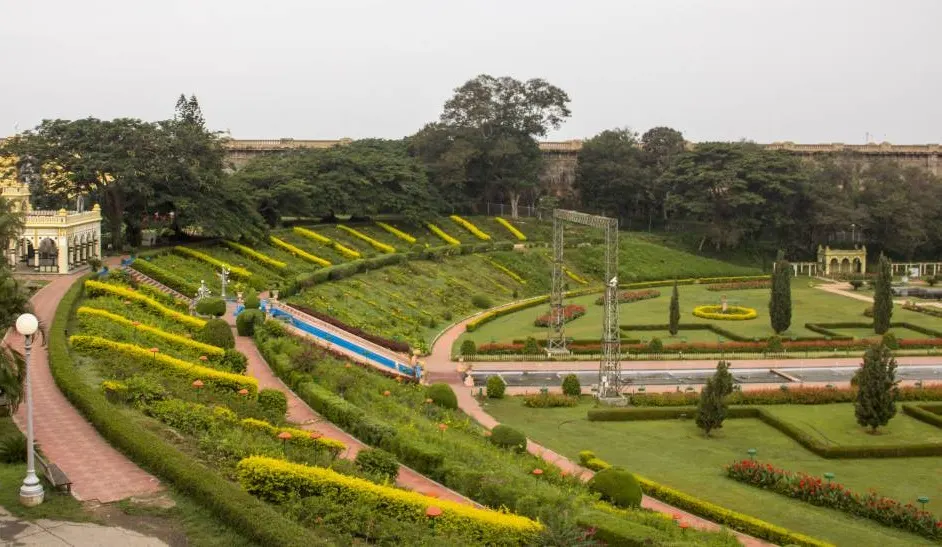
There were terraces, water channels, fountains, lawns, flower beds and pathways. Water was an important part of the visual design, which makes sense considering the garden sits below a huge reservoir and dam.
This is something I would tell anyone visiting for the first time: don’t walk through Brindavan Gardens only looking at the flowers. Look at the way the whole garden is arranged. You will notice the symmetry much more clearly.
Who Designed Brindavan Gardens?
There is a little confusion online about who exactly should get credit for the garden.
Sir Mirza Ismail is closely connected with the conception and development of Brindavan Gardens. The actual landscape and horticultural planning is widely associated with Gustav Hermann Krumbiegel, a German botanist and landscape designer who worked with the Mysore government. .
Krumbiegel had already made a name for himself through his work with gardens in the region, including his association with Lalbagh in Bengaluru.
The design of Brindavan Gardens also took inspiration from Shalimar Gardens in Kashmir, especially the use of terraces, water channels and geometric layouts.
So, if you want the simple version:
| Person / Project | Role |
|---|---|
| Sir Mirza Ismail | Vision and development of the garden |
| G.H. Krumbiegel | Landscape and horticultural design |
| KRS Dam | Engineering project beside which the garden was developed |
| Mysore administration | Overall development and implementation |
This distinction matters because people sometimes describe the dam and garden as if they were exactly the same project. They weren’t. They were closely related, but each had its own purpose.
KRS Dam and Brindavan Gardens: Why Were They Built Together?
The location of Brindavan Gardens is not an accident.
The garden lies below the KRS Dam, close to the Kaveri River. The dam had an important practical purpose—irrigation and water supply—while the garden gave the area a completely different character.
It became a place for recreation, landscaping and public enjoyment.
The Mandya district administration describes Brindavan Gardens as being at the bottom of the dam site and notes that the gardens helped make KRS famous.
Think about the setting for a moment.
You have a massive engineering structure above you. Then, below it, there is a carefully planned garden with terraces, water channels, fountains and greenery.
That contrast is probably one of the reasons the place became such a popular attraction.
The garden also made use of the area’s water resources in its design. Water was not just something in the background. It became part of the garden itself.
When I walk through the place, this is usually what I pay attention to first. The straight channels and different levels make much more sense when you know that the garden was designed around water and symmetry.
And yes, the photos don’t always show that properly.
You have to actually walk through it.
The garden later became one of the best-known attractions associated with Mysore tourism. There is one small detail worth knowing, though: Brindavan Gardens is technically in Mandya district, even though almost every traveller associates it with Mysuru.
For visitors staying in Mysuru, that hardly changes anything. It is only around 20–21 km away by road.
How Brindavan Gardens Changed Over the Years
The Brindavan Gardens you see today is not exactly the same garden that visitors saw in the 1930s.
The original concept was based around a formal terraced garden. There were lawns, ornamental plants, flower beds, fountains, water channels and walking paths. The entire garden covers roughly 60 acres, with its three-terrace arrangement being one of its most recognisable features.
Over the years, visitor facilities and attractions were added or modified.
The musical fountain eventually became the star attraction.
And let’s be honest—this is what most families are waiting for today.
As evening comes, the fountains, lights and music turn the garden into a completely different place. It is much more of a show now than it would have been in its early years.
The musical fountain and fountain systems also went through renovation work, including a significant renovation in 2005.
This is one reason you should be careful with very old travel guides.
You may find an article from several years ago mentioning a particular fountain timing, ticket rate or facility. That information may no longer match what you see when you arrive.
The basic garden has survived, though.
The terraces are still there. The water channels are still an important part of the design. The KRS Dam still forms the dramatic backdrop.
And the garden still attracts a huge number of visitors.
Some things change. The main idea doesn’t.
Timings, Ticket Price & Entry Fee (2026 Updated)
If you are visiting Brindavan Gardens mainly to understand its design and history, don’t arrive five minutes before the fountain show.
You will miss half the experience.
I would keep at least 1.5 to 2 hours for the visit.
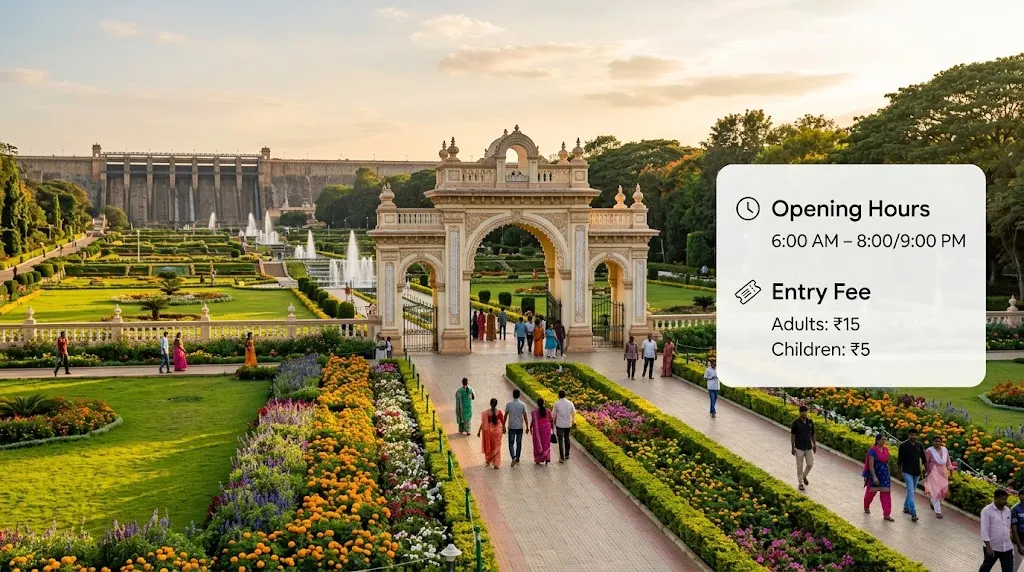
Current online information about exact entry charges and timings is not completely consistent. Karnataka Tourism lists the attraction and provides current visitor information, while other travel websites show different figures.
So rather than giving you a random number and calling it a “2026 updated price,” I would suggest checking the official ticket counter when you arrive.
Practical 2026 Visit Information
| Information | What to Expect |
|---|---|
| Location | KRS Dam area, near Krishnarajasagara |
| Distance from Mysuru | Around 20–21 km |
| Garden | About 60 acres |
| Best arrival time | Around 4:30–5:30 PM |
| Evening experience | Garden + sunset + illumination |
| Musical fountain | Evening; timing can vary |
| Parking | Available near the attraction, charges may apply |
Karnataka Tourism’s current listing, updated in July 2026, also recommends the evening period because visitors can see the garden in daylight and then stay for the fountain experience.
My advice?
Reach before sunset.
That gives you the best of both sides.
You get the proper view of the garden first, and then you can stay for the evening atmosphere.
Also, don’t assume that the fountain schedule you saw on an old Google result is automatically valid. Timings can change because of maintenance, weather, local conditions or special events.
Best Time to Visit Brindavan Gardens for Its History and Design
For someone interested in the history and actual garden layout, late afternoon is the best time.
I normally prefer arriving somewhere between 4:30 PM and 5:30 PM.
The reason is simple.
You can see everything properly.
The terraces, flowers, pathways and water channels are much easier to appreciate before it gets dark. You can also walk around without feeling like you are racing against the fountain show.
Then comes sunset.
And after that, the atmosphere changes.
Lights come on, people start gathering and everyone’s attention slowly moves towards the musical fountain.
How to Reach
Brindavan Gardens is around 20–21 km from Mysuru. From the city, follow the road towards KRS Dam / Krishnarajasagara.
Depending on traffic and where you start from, the drive generally takes around 30–45 minutes.
You can reach by:
- Private car
- Taxi
- Local bus services towards KRS
- Auto or cab from nearby areas
If you are planning a full-day trip, a simple route can be:
Mysuru → Srirangapatna area → KRS Dam → Brindavan Gardens → evening fountain
That works quite nicely.
Just don’t cram ten places into the same day. You will end up seeing everything and enjoying nothing. Thoda slow travel also works here.
My Personal Tips & Common Mistakes to Avoid
After visiting Brindavan Gardens many times, I would say the biggest mistake is assuming it is a quick 30-minute stop.
It isn’t.
The garden is spread over a fairly large area. Add photographs, family stops, food breaks and the fountain show, and your visit can easily stretch to two hours or more.
Here are the things I would keep in mind.
1. Arrive before sunset
This is the most useful tip I can give.
Come early enough to explore the garden in daylight.
Once the lights come on, the atmosphere is nice, but you lose some of the details of the original landscaping.
2. Don’t rush straight to the fountain
I know everyone wants a good seat.
Still, walk through the garden first.
Look at the terraces. Notice the water channels. See how the garden is divided into different levels.
The fountain is only one part of Brindavan Gardens.
3. Wear comfortable footwear
You will walk more than you expect.
The garden is large, and if you want to explore rather than just sit somewhere, comfortable shoes make a real difference.
4. Weekends can be crowded
Saturday and Sunday evenings can get busy, particularly during holidays and peak tourist periods.
If you prefer a more relaxed visit, try a weekday.
5. Don’t depend completely on old online timings
This is important in 2026.
Older travel pages can still appear in search results, even when their ticket prices or fountain timings have changed.
Check the latest notice at the entrance.
6. Keep extra time in your schedule
If you are travelling with children or older family members, avoid making another important appointment immediately after Brindavan Gardens.
The walk, crowd and evening traffic can take longer than expected.
And one small thing I personally like doing—before leaving, turn around and look towards the KRS Dam.
The scale of the dam above the formal garden is impressive.
It is one of those views that makes you understand why this location was chosen in the first place.
Nearby Places to Visit
If you are already travelling towards KRS, you can easily turn Brindavan Gardens into part of a larger Mysuru or Srirangapatna day.
KRS Dam
Obviously, start with the Krishna Raja Sagara Dam itself.
Its history is closely connected with the development of the garden. The dam was built as a major water-resource project across the Kaveri River and played an important role in irrigation and water supply in the region.
It also helps you understand the setting of the garden.
Srirangapatna
Srirangapatna is another worthwhile stop if you have enough time.
The historic island town has several monuments and sites connected with the history of the Mysore region.
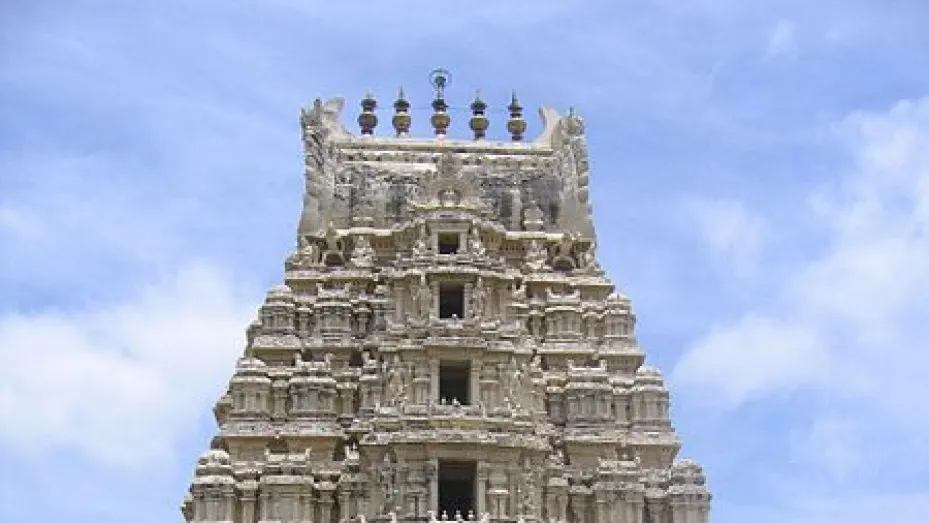
It is a good place to explore during the day before heading towards KRS in the evening.
Ranganathittu Bird Sanctuary
If you enjoy nature and birdwatching, Ranganathittu can be added to the itinerary.
It works particularly well as a daytime stop before going towards Brindavan Gardens later in the day.
Mysuru City
If you are staying in Mysuru, don’t feel that you have to visit everything on the same day.
Mysore Palace, Mysore Zoo and Chamundi Hills can be planned separately.
A relaxed itinerary is usually better than trying to collect attractions like a checklist.
For Brindavan Gardens, give yourself enough time. The place is more enjoyable that way.
Frequently Asked Questions
Who built Brindavan Gardens?
Brindavan Gardens was developed during the period of the Mysore State under the vision of Sir Mirza Ismail, the then Diwan of Mysore. Landscape planning is widely associated with Gustav Hermann Krumbiegel.
When was Brindavan Gardens built?
The garden’s development began in 1927 and was completed around 1932. Its development was closely connected with the KRS Dam project.
Who designed Brindavan Gardens?
Gustav Hermann Krumbiegel, a German botanist and landscape designer associated with the Mysore government, is widely credited with the garden’s landscape design and horticultural planning.
Why is Brindavan Gardens famous?
It is famous for its terraced landscape, fountains, flower beds, water channels, evening illumination and musical fountain show. Its location below the KRS Dam adds to its importance.
Is Brindavan Gardens in Mysore?
Brindavan Gardens is commonly marketed as a Mysore attraction because it is only about 20–21 km from Mysuru. Administratively, however, it is in Mandya district near Krishnarajasagara.
Final Thoughts
The History of Brindavan Gardens is not just the story of a beautiful tourist spot.
It is tied to the development of the KRS Dam, the old Mysore State and the vision of creating a carefully planned landscape around an important engineering project.
Work on the garden started in 1927 and was completed around 1932. Sir Mirza Ismail played an important role in its development, while Gustav Hermann Krumbiegel is widely associated with its landscape and horticultural design.
The garden has changed over the decades. The musical fountain, lights and modern visitor facilities have made it a major tourist attraction. But the original idea is still visible if you take your time.
So, my recommendation is simple.
Reach in the late afternoon. Walk through the terraces while there is still daylight. Look at the water channels and the overall layout. Then stay back for the evening fountain and lights.
Once you know the history, Brindavan Gardens doesn’t feel like just another photo stop near Mysuru.
It starts making sense.
And honestly, that’s when the place becomes much more interesting.

name vn, founder of BrindavanaGarden.com. I write practical travel guides based on detailed research to help visitors plan their trip to Brindavan Gardens and nearby attractions in Mysore. My articles cover timings, tickets, travel tips, hotels, rules, and other useful visitor information to make every visit easier.